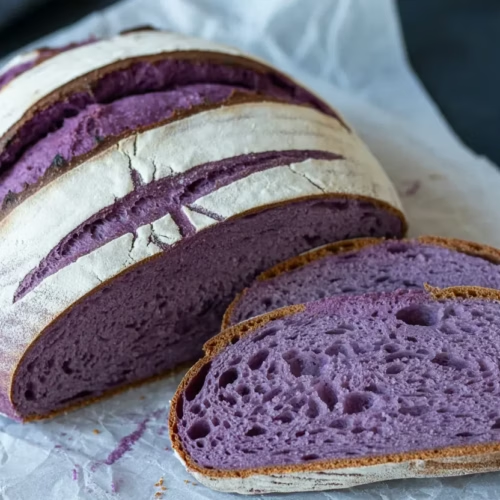
Purple Sweet Potato Sourdough Bread
This stunning Purple Sweet Potato Sourdough Bread features a naturally vivid violet crumb, a shattering crust, and a beautifully balanced flavor that combines tangy sourdough with gentle earthy sweetness. It uses roasted purple sweet potato for both color and moisture, keeping the loaf tender and fresh for days. A showstopping yet approachable bake for any sourdough enthusiast.
Equipment
- Dutch oven (5-quart or larger)
- Kitchen scale
- Large mixing bowl
- Bench scraper
- Banneton proofing basket or bowl with kitchen towel
- Bread lame or sharp razor blade
- Wire cooling rack
- Parchment paper
Ingredients
- 200 g purple sweet potato roasted and mashed smooth, cooled completely
- 400 g bread flour plus more for dusting
- 50 g whole wheat flour
- 300 g room temperature water divided: 280g for autolyse, 20g reserved
- 100 g active sourdough starter fed 6 to 8 hours prior, at peak activity
- 10 g fine sea salt
- 1 tablespoon honey optional, for added sweetness and browning
Instructions
- Roast the purple sweet potato: Pierce a medium purple sweet potato all over with a fork and roast at 400°F (200°C) for 45 to 55 minutes until completely tender when pierced. Let cool fully, then peel and mash until completely smooth. Spread on a plate and microwave in 30-second bursts to remove excess moisture if the mash seems wet. Weigh out 200g and set aside.
- Autolyse the dough: In a large mixing bowl, combine the bread flour, whole wheat flour, 280g of the water, and all 200g of the mashed purple sweet potato. Mix with your hands or a stiff spatula until no dry flour remains and the potato is evenly distributed. The dough will look rough. Cover the bowl and rest for 45 minutes at room temperature.
- Incorporate starter and salt: Add the active sourdough starter to the dough and use wet hands to squeeze and fold it in until fully absorbed, about 3 minutes. Sprinkle the fine sea salt evenly over the dough, add the remaining 20g of water (and honey if using), and continue squeezing and folding until everything is fully integrated and the dough feels cohesive, about 3 to 5 more minutes.
- Bulk fermentation with stretch and folds: Cover the bowl and begin bulk fermentation at room temperature, ideally 75 to 78°F (24 to 26°C). During the first 2 hours, perform a set of stretch and folds every 30 minutes for a total of 4 sets. For each set, grab one side of the dough, stretch it up, and fold it over the center, rotating the bowl 90 degrees and repeating 4 times per set. After the 4 sets, leave the dough undisturbed for another 2 to 3 hours until it has grown 50 to 75 percent in volume and appears domed and jiggly when the bowl is gently shaken.
- Shape the loaf: Gently turn the fermented dough onto a clean, unfloured surface. Using a bench scraper and your hands, shape the dough into a tight boule (round) or batard (oval) by pulling it toward you across the surface to build tension. The surface should feel taut. Place the shaped dough seam-side up into a well-floured banneton or a bowl lined with a generously floured kitchen towel, using rice flour if available to prevent sticking.
- Cold proof: Cover the banneton with a reusable plastic cover or shower cap and refrigerate for 10 to 16 hours. The dough should rest cold overnight. This slow cold proof develops flavor depth and makes the dough much easier to score cleanly the next day.
- Preheat oven and Dutch oven: Place your Dutch oven (lid on) inside the oven and preheat to 500°F (260°C) for at least 45 minutes. You want the Dutch oven thoroughly saturated with heat before the dough goes in.
- Score and bake covered: Cut a piece of parchment paper to fit your Dutch oven. Remove the cold dough from the refrigerator and turn it out onto the parchment, seam-side down. Using a bread lame or a sharp razor blade, score the dough with one confident slash at a 30 to 45 degree angle, or add a decorative pattern. Carefully lower the dough on parchment into the hot Dutch oven. Place the lid on and bake at 500°F (260°C) for 20 minutes. The steam trapped inside creates an excellent crust and maximum oven spring.
- Bake uncovered: Remove the lid, reduce the oven temperature to 450°F (230°C), and continue baking for 20 to 25 minutes until the crust is a deep golden brown and the internal temperature of the loaf reads 205°F (96°C) on an instant-read thermometer. The loaf should sound hollow when tapped on the bottom.
- Cool completely: Carefully lift the loaf out of the Dutch oven using the parchment paper and transfer it to a wire cooling rack. Allow the bread to cool for a minimum of 1.5 to 2 hours before slicing. Cutting too early will result in a gummy, undercooked-seeming crumb as the internal steam needs time to redistribute and set the structure. Slice and enjoy.
Notes
The color of the crumb will shift from vivid purple in the raw dough to a more muted lavender or blue-gray after baking due to the heat-sensitivity of anthocyanins. This is completely normal and the bread will still be beautifully colored. For a more intense color and flavor, add half a teaspoon of ube extract along with the mashed potato. Store the cooled loaf wrapped at room temperature for up to 4 days, or slice and freeze for up to 3 months. Do not refrigerate whole loaves as it accelerates staling. To reheat a full loaf, wrap in foil and warm in a 325°F oven for 15 to 20 minutes.